
My favorite kind of morning happens in late summer, when the sun is still rising early due to daylight saving time and the sun hasn't yet had its coffee. It's cool but not cold, still full of summer, and everything feels like it's just rained even if it hasn't.
There's a certain smell about it that reminds me of going to camp with my grandpa as a kid. I'd wake up in the cabin, next to which the camper had been parked, push open the door, and walk out towards where the fire had been.
It's the deep and enveloping smell of dirt and dew and gravel parting under my tennis shoes. It's the heavy blanket of mist and dampness held close about the earth: the world waking up after a long nap still hot and sticky with sweat under the bedsheets.
That smell, that perfluence of aromas and gathering of old memories, always makes me expect to see that same salamander, bright and orange, that I found underneath the camper that one morning.
Above all, it's quiet. I mean the kind of quiet that you get in the suburbs, with the shush of cars along the pavement in the distance and the neighbor's dog barking. But it still feels quiet and close and personal.
It's the kind of morning where I just want to take in as many slow, lazy breaths as I can as I swim through the thick atmosphere and feel the occasional whispering breeze sliding through my shirt sleeves, up one arm and down the other.
Just a pity those mornings only last for such a short space of time, before the world turns cold once again.
Peace,
JT
Showing posts with label personal reflections. Show all posts
Showing posts with label personal reflections. Show all posts
05 September 2014


09 July 2014
Will Current-Gen Games Be Collectible? []
This is a serious question I was asking myself the other day, and I'm sure it's one others have asked as well. It's a question that may seem odd at first, but the more I look at current trends in the video game industry, the more I begin to suspect that it will be much more difficult for people in the 2040s and 2050s to be retro collectors for current-generation games.
"But JT, you numb-witted fearmonger!" you shout at me, "surely you must be jesting. There will always be those who collect games, and perhaps you're just bigoted against the present generation and hence simply want to take opportunity to disparage it via Internet weblog post!"
Believe me, I've got plenty of disparagement to hurl at some of the current-gen systems and games, but this isn't just about my love of systems from the '80s and early '90s. This is just something I'm noticing, and something about which I'm hoping I'm wrong. Let me elucidate my reasoning:
Lamentably, this is what seems to be happening. I first noticed this trend when they introduced the PSP Go, which completely ditched the traditional physical media for games downloaded from the PlayStation Network onto Sony Memory Sticks. The PSP Go was a bit of a flop, but the idea stuck, and now it's everywhere.
Whether via PSN, XBLA, whatever the Wii uses, Steam, Origin, and too many others to list, the last few years have seen a large rise in games delivered via download instead of physical media (disc, cartridge, floppy diskette, etc).
This is a major step forward in convenience to the user, without question. I've personally downloaded a number of games via PSN to my PS3 and PSP, many of them retro titles like Metal Slug, King of Fighters '95, R-Type Delta (yes, PS2 counts), et al. Not only is downloading them easier than tracking them down at a resale store or flea market/garage sale, but it's a lot cheaper.
This means that (a) a lot more people will be encouraged to play games they otherwise wouldn't, and (b) the costs for independent developers to produce a title need no longer be bound by the cost for producing the physical medium plus packaging.
At this point, you're now re-reading the title of this post and realizing what this means for collecting. Simply put, digitally downloaded games are platform-dependent and service-dependent. They last so long as there is still a platform to play them and a service that can provide them. So, by way of example, were PSN ever to go away:
On that note:
Let us all thank social media and public outcry for scoring a major victory last year. Microsoft was all set to release their Xbox One console with built-in DRM that would effectively nullify the ability to trade in games or share with friends. We stopped that. At least for now, that is.
Even with that pat-on-the-back moment to our credit, it's just a fact of the world now that DRM is and will continue to be present on new software titles for all platforms. It's going to be there, and there's no saying that in the future they won't try again to use DRM to cut off used game sales at the knees. It's already being done at the game level in some cases (see 2011's Mortal Kombat), with "passes" that require players who buy the game used to pay extra for the right to play the game they already purchased.
This directly affects collectors, because it makes both resale and purchase thereof more difficult. With current retro collecting, you can pick through a group of loose cartridges, pay whatever the seller asks (and maybe less if you bargain correctly), and use them as if you were the original owner on your own console. In the future, this will almost certainly not be the case.
What does that do for collecting? Same effect as moving to digital games. Nobody is going to be collecting copies of Angry Birds or Temple Run (even if, for some reason, they wanted to do so) for the simple reason that they don't exist apart from a mobile device and an account that says you bought the game.
Let me reiterate: this is where the market is growing on an incredible level, and it's where the money is. Mobile games can be sold for free on the knowledge that users will likely pay more for add-on content than they would for the game up-front. This is great for the economy, but not so much for collectors. If all games go mobile, we just won't be collecting them in the future.
I love DLC because it (a) expands the life cycle of a game and (b) allows any major flaws to be corrected without having to re-purchase the game.
I hate DLC because (a) it allows developers to release unfinished games and charge ransom for fixing it; (b) it means that whenever you think you've bought a game, you haven't really bought the game.
Let me illustrate with a common experience: you've just bought Shiny-Awesome-Game for PS3, a couple weeks after the release date. You paid $60 for it, and it's got that wonderful new-game smell to it. You tear off the plastic wrap, open up the case, and pop it into your console. It's ready to go, right?
Well, it would be ready to go, except that you first must download "the most recent version" of the game, because there's been a patch already. Actually, I've gotten pre-ordered games that had updates pre-release. See my first reason above for hating DLC.
Even though patches and upgrades are often free, I still consider them as holding the game for ransom, because it means that, essentially, you haven't bought the game just by purchasing it from the store. This is doubly true for purchased DLC (and triply so for disc-locked content that's actually on the disc but won't be available until you buy it).
Imagine a future collector buying Shiny-Awesome-Game for PS3 in 2034. He dusts off his PS3, boots it up, puts in the disc, and has to hope there's still a PSN around, at least one that will still speak to his PS3, or else he's only going to be able to play the initially available version on the disc. Who'd want to collect that?
Essentially, CDs will accumulate scratches which expose the data layer to the air, causing oxidation and hence data loss. Once the data's lost due to disc rot, it's just gone. While ROM cartridges have an incredible shelf life (my Atari games from the 1970s – almost 40 years old now – still work just fine), it's really only a matter of a decade or so before CDs start to degrade. DVDs last longer, due to their better protective coating, but they're still susceptible. I've even seen stories of Blu-ray discs going bad already, although those may be just bad batches (do a Google search to see the horror stories for yourself). So this is a problem that will affect current games less, but may still become an ever-increasing problem.
By the way: this affects solid-state storage (like flash drives and memory cards) as well. Keep backups of your games for PSP, in other words.
Where do we go from here? Well, unfortunately there's not much we can do. It makes great business sense to move to the digital distribution model, so there's not much stopping it. We can protest DRM all we want, but it's going to persist.
If all else fails, though...well, let's see how long my Atari lasts.
Peace,
JT
"But JT, you numb-witted fearmonger!" you shout at me, "surely you must be jesting. There will always be those who collect games, and perhaps you're just bigoted against the present generation and hence simply want to take opportunity to disparage it via Internet weblog post!"
Believe me, I've got plenty of disparagement to hurl at some of the current-gen systems and games, but this isn't just about my love of systems from the '80s and early '90s. This is just something I'm noticing, and something about which I'm hoping I'm wrong. Let me elucidate my reasoning:
1. Gaming is going digital.
Collecting anything usually requires that that thing be physical (well, unless it's Pokemon or something). So when games stop being physical, they stop being collectible in the essential sense.Lamentably, this is what seems to be happening. I first noticed this trend when they introduced the PSP Go, which completely ditched the traditional physical media for games downloaded from the PlayStation Network onto Sony Memory Sticks. The PSP Go was a bit of a flop, but the idea stuck, and now it's everywhere.
Whether via PSN, XBLA, whatever the Wii uses, Steam, Origin, and too many others to list, the last few years have seen a large rise in games delivered via download instead of physical media (disc, cartridge, floppy diskette, etc).
This is a major step forward in convenience to the user, without question. I've personally downloaded a number of games via PSN to my PS3 and PSP, many of them retro titles like Metal Slug, King of Fighters '95, R-Type Delta (yes, PS2 counts), et al. Not only is downloading them easier than tracking them down at a resale store or flea market/garage sale, but it's a lot cheaper.
This means that (a) a lot more people will be encouraged to play games they otherwise wouldn't, and (b) the costs for independent developers to produce a title need no longer be bound by the cost for producing the physical medium plus packaging.
At this point, you're now re-reading the title of this post and realizing what this means for collecting. Simply put, digitally downloaded games are platform-dependent and service-dependent. They last so long as there is still a platform to play them and a service that can provide them. So, by way of example, were PSN ever to go away:
- You would need to maintain that PS3/PS4/PSP/PS Vita (and not all PSN games can play on all of those). More specifically, the storage device which holds the data for your game on that device. Better hope the hard drive never crashes or the memory card never gets corrupted.
- Even so, a lot of digital titles require you to be logged into PSN to validate that you own the game. Therefore, you may not even be able to start it anymore.
On that note:
2. Game purchases are becoming non-transferable.
We as gamers are not tremendous fans of Digital Rights Management (DRM), although we know why it exists. Piracy hurts sales, and that discourages developers from producing more product. Thus, panicky producers pick pesky, ponderous protection packages to perplex proponents of perfidious piracy (for a while), in the meanwhile peeving paying patrons.Let us all thank social media and public outcry for scoring a major victory last year. Microsoft was all set to release their Xbox One console with built-in DRM that would effectively nullify the ability to trade in games or share with friends. We stopped that. At least for now, that is.
Even with that pat-on-the-back moment to our credit, it's just a fact of the world now that DRM is and will continue to be present on new software titles for all platforms. It's going to be there, and there's no saying that in the future they won't try again to use DRM to cut off used game sales at the knees. It's already being done at the game level in some cases (see 2011's Mortal Kombat), with "passes" that require players who buy the game used to pay extra for the right to play the game they already purchased.
This directly affects collectors, because it makes both resale and purchase thereof more difficult. With current retro collecting, you can pick through a group of loose cartridges, pay whatever the seller asks (and maybe less if you bargain correctly), and use them as if you were the original owner on your own console. In the future, this will almost certainly not be the case.
3. Gaming is moving away from consoles.
You don't have to be Sherlock Holmes to observe how quickly the mobile and online game market is growing. Nearly everyone in the United States has some form of mobile device, and even I have been known to use my phone to play Tetris or Solitaire in a spare moment. Whether on Android, iOS, or Facebook, the mobile/web platform is growing steadily, taking more and more time and money away from console gaming.What does that do for collecting? Same effect as moving to digital games. Nobody is going to be collecting copies of Angry Birds or Temple Run (even if, for some reason, they wanted to do so) for the simple reason that they don't exist apart from a mobile device and an account that says you bought the game.
Let me reiterate: this is where the market is growing on an incredible level, and it's where the money is. Mobile games can be sold for free on the knowledge that users will likely pay more for add-on content than they would for the game up-front. This is great for the economy, but not so much for collectors. If all games go mobile, we just won't be collecting them in the future.
4. Buying a game no longer buys you the whole game.
While we're on that subject, let's talk about DLC. I love DLC; I hate DLC. You'll hear both opinions, and I happen to share both, depending on the context.I love DLC because it (a) expands the life cycle of a game and (b) allows any major flaws to be corrected without having to re-purchase the game.
I hate DLC because (a) it allows developers to release unfinished games and charge ransom for fixing it; (b) it means that whenever you think you've bought a game, you haven't really bought the game.
Let me illustrate with a common experience: you've just bought Shiny-Awesome-Game for PS3, a couple weeks after the release date. You paid $60 for it, and it's got that wonderful new-game smell to it. You tear off the plastic wrap, open up the case, and pop it into your console. It's ready to go, right?
Well, it would be ready to go, except that you first must download "the most recent version" of the game, because there's been a patch already. Actually, I've gotten pre-ordered games that had updates pre-release. See my first reason above for hating DLC.
Even though patches and upgrades are often free, I still consider them as holding the game for ransom, because it means that, essentially, you haven't bought the game just by purchasing it from the store. This is doubly true for purchased DLC (and triply so for disc-locked content that's actually on the disc but won't be available until you buy it).
Imagine a future collector buying Shiny-Awesome-Game for PS3 in 2034. He dusts off his PS3, boots it up, puts in the disc, and has to hope there's still a PSN around, at least one that will still speak to his PS3, or else he's only going to be able to play the initially available version on the disc. Who'd want to collect that?
5. Everything has a life-span, especially optical media.
I saved this one for last because it's probably the weakest point, but it's still important. In fact, it's one that currently affects collectors for CD-based consoles (Sega CD, Atari Jaguar, Sega Saturn, etc). It's called disc rot. Sounds like a horrible disease, and it is. And it's incurable.Essentially, CDs will accumulate scratches which expose the data layer to the air, causing oxidation and hence data loss. Once the data's lost due to disc rot, it's just gone. While ROM cartridges have an incredible shelf life (my Atari games from the 1970s – almost 40 years old now – still work just fine), it's really only a matter of a decade or so before CDs start to degrade. DVDs last longer, due to their better protective coating, but they're still susceptible. I've even seen stories of Blu-ray discs going bad already, although those may be just bad batches (do a Google search to see the horror stories for yourself). So this is a problem that will affect current games less, but may still become an ever-increasing problem.
By the way: this affects solid-state storage (like flash drives and memory cards) as well. Keep backups of your games for PSP, in other words.
Okay, JT, we get it...final thoughts?
So all of these factors are what have me worrying about the future of collecting. It's not that games being released now aren't good enough to be worth collecting (well...not just that) or that the market is about to collapse, leaving games worth nothing (we've survived that before), but simply that future collectors may not have anything that can be collected.Where do we go from here? Well, unfortunately there's not much we can do. It makes great business sense to move to the digital distribution model, so there's not much stopping it. We can protest DRM all we want, but it's going to persist.
If all else fails, though...well, let's see how long my Atari lasts.
Peace,
JT
02 July 2014
Feeling blue...with labels...[]
Last time, I discussed the expansive variety exhibited in cartridges for the Atari 2600 by various game companies. I know I've missed a few, and in fact in a future post I will address these, but today I've decided to talk about a related topic: label variations.
Anyone who's collected Atari games knows that many games, especially those made by Atari, have at least two variations: the picture label and the text label.


Of course there are other variation types, and if you care to check on all of them, AtariAge.com has a guide which lists variations by company.
Today, though, I'm just going to discuss one specific label type: the Activision "blue label" variety.

Anyone who's collected Atari games knows that many games, especially those made by Atari, have at least two variations: the picture label and the text label.
Source: AtariAge.com
Of course there are other variation types, and if you care to check on all of them, AtariAge.com has a guide which lists variations by company.
Today, though, I'm just going to discuss one specific label type: the Activision "blue label" variety.
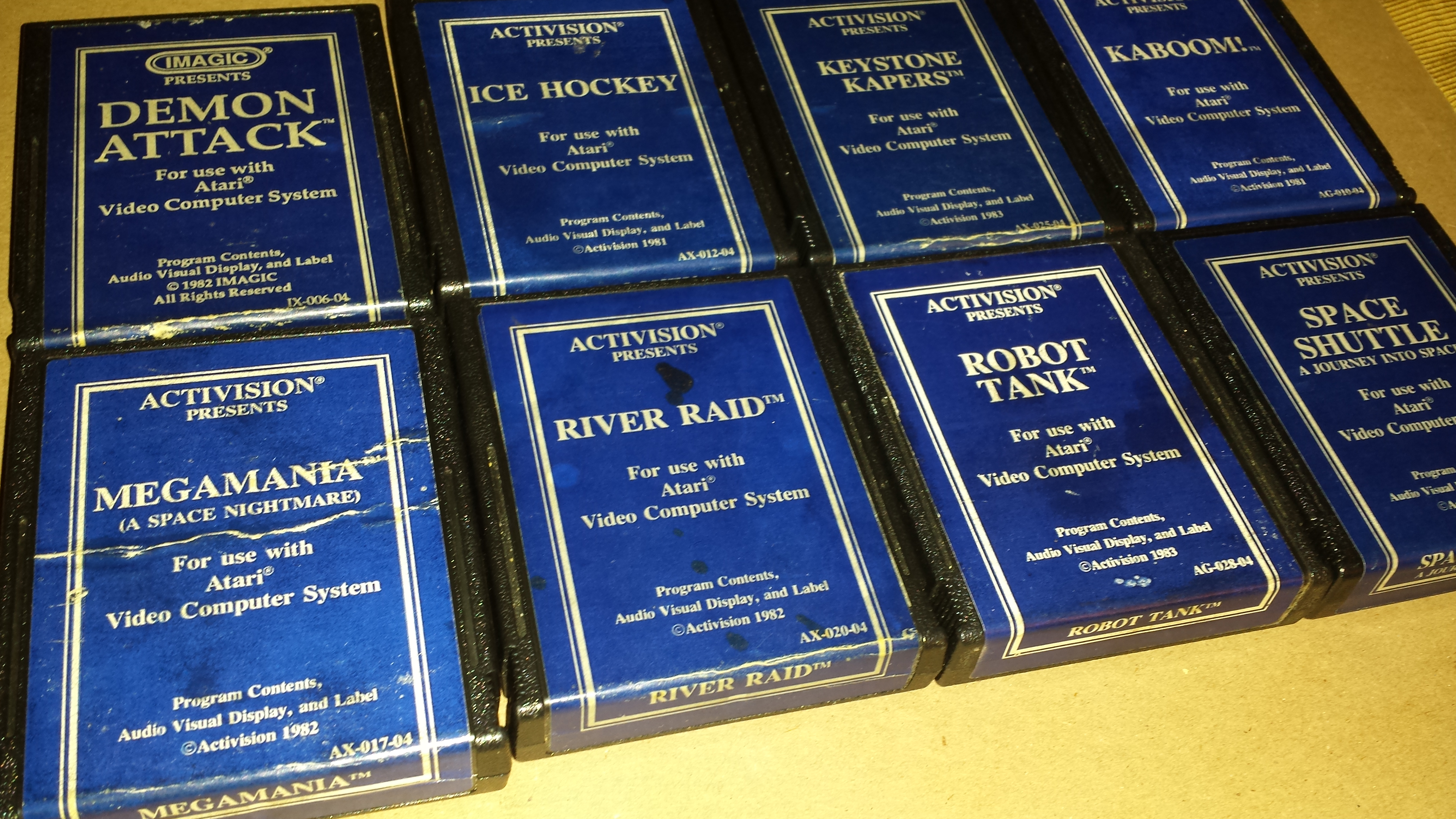
These were produced by Activision in the late '80s to save production costs * in a time when the video game business was just recovering from a horrible crash. The Atari 2600 had also been on the market for a decade, and competition from other companies (i.e. Nintendo) meant that people weren't buying for Atari as much as before. This was a horrible thing.**
You may notice that some of the cartridges up there don't say Activision, but Imagic. This points to one of the tragedies of the Video Game Crash of 1983 (see link above), the loss of so many independent game companies. Imagic went under in the mid-80s, and the rights to their games went to Activision.
Perhaps this was only right, since, like Activision, Imagic was formed by a group of ex-Atari designers who wanted to do things their way. At least Activision gave their games the dignity of being presented by their original company.
 Depending on whom you ask, you may hear that the blue label versions are much more valuable, just a little more valuable, or really not any more valuable than the regular versions. It really depends on the buyer/seller, and what's considered as adding to the value.
Certainly, the blue label versions are less common than the regular versions, so rarity may be an issue. The rarity gradient may vary by game, however, so this won't always be a definite increase.
Some people, like me, enjoy getting cartridge variations, so they may see more value in obtaining a version they don't already have. Of course, this can work both ways, if the person already has the blue-label version.
And then there may be those who just don't like the alternates, and only want the picture labels. You'll always find those people; you may even be one of them.
Also, Activision games are almost universally awesome anyway.

So there you go. Look out for the blue labels, either because you want to add something different to your collection, or because you want to avoid them. The power is yours.
Peace,
JT
* During the same time, Atari was re-releasing cartridges with the "red label" variant, notable for having red labels with black-and-white label art.
** I reserve the right to add subjective comments based on my own opinions in my own blog.
You may notice that some of the cartridges up there don't say Activision, but Imagic. This points to one of the tragedies of the Video Game Crash of 1983 (see link above), the loss of so many independent game companies. Imagic went under in the mid-80s, and the rights to their games went to Activision.
Perhaps this was only right, since, like Activision, Imagic was formed by a group of ex-Atari designers who wanted to do things their way. At least Activision gave their games the dignity of being presented by their original company.
So are they worth anything?
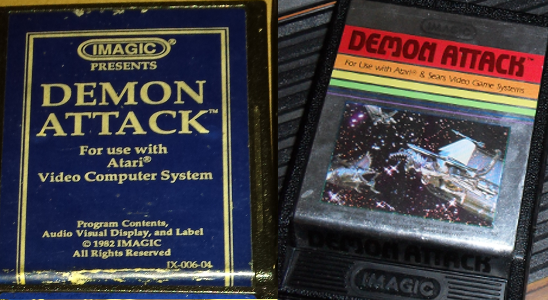
Which is better?
Certainly, the blue label versions are less common than the regular versions, so rarity may be an issue. The rarity gradient may vary by game, however, so this won't always be a definite increase.
Some people, like me, enjoy getting cartridge variations, so they may see more value in obtaining a version they don't already have. Of course, this can work both ways, if the person already has the blue-label version.
And then there may be those who just don't like the alternates, and only want the picture labels. You'll always find those people; you may even be one of them.
So Why Do I Like Them?
This one's hard to say. They're not particularly interesting to look at, and they don't increase the value all that significantly. I suppose I just like them because they're different. They look almost like "special editions" with labels reminiscent of blueprints (not the game Blueprint, though).Also, Activision games are almost universally awesome anyway.

Especially Stampede. Source: videogamecritic.com
So there you go. Look out for the blue labels, either because you want to add something different to your collection, or because you want to avoid them. The power is yours.
Peace,
JT
* During the same time, Atari was re-releasing cartridges with the "red label" variant, notable for having red labels with black-and-white label art.
** I reserve the right to add subjective comments based on my own opinions in my own blog.
28 June 2014
How I became an Atari guy...[]
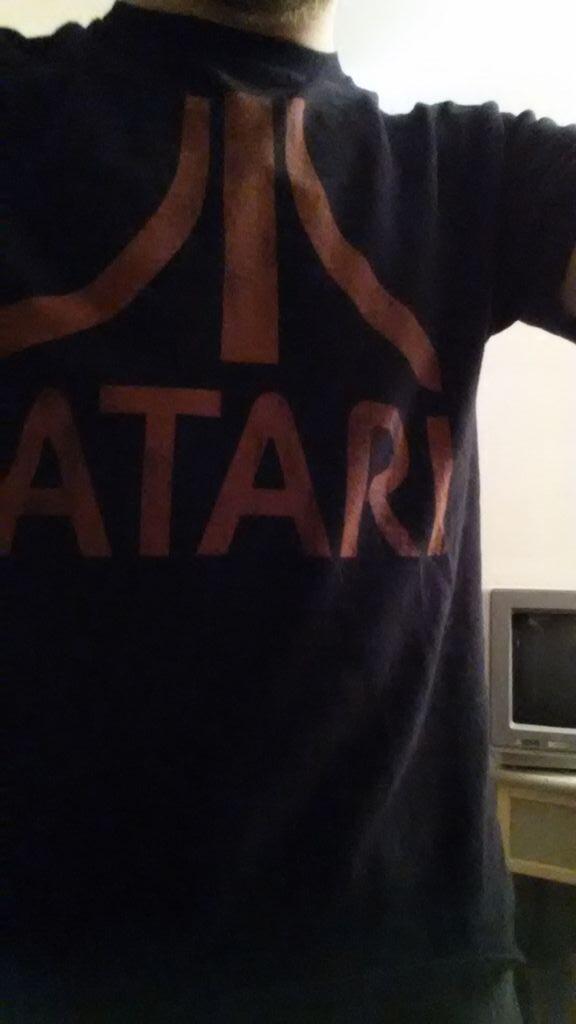
So those who know me are probably aware that I'm more than just a bit of an Atari fanatic.
I've so far amassed a considerable collection of Atari games and consoles (and computers), and am showing little signs of stopping.
I'm also prone to enthusiastic endorsements of all things Atari, at the expense of other consoles and companies. I'll casually mention that I can't remember the last time I used my PlayStation 3 (okay, so I used it to watch Hulu this morning), or I'll ask if [insert popular game of current generation] has been released for Atari 2600. That kind of thing.
I wasn't always this way, though. In fact, it wasn't until just a couple years ago that I'd ever even played Atari. Really.
Having been born in 1986 (which I refer to as "the year the Atari 7800 was finally released"), I didn't reach video game age until the '90s. Moreover, since we didn't always have a lot of money in my family, video game consoles weren't exactly a common sight in my household.
Confession: my first console was the PlayStation 2, which I received for my fifteenth birthday, in 2001. Seriously. Unless you count the GameBoy Pocket for which I only ever had one game, that was the first console in my house.
All right; we've established that I really shouldn't have any gaming cred whatsoever. Well, okay, so there was an NES at the daycare when I was a kid, and every now and then I got a turn at Super Mario Bros. or Duck Hunt or 1941. And every time we'd head to Sears, I'd find my way to the electronics section and gawk at the video games there, playing all the demos.
I guess that's really what pushed me into retro video game collecting.
It was September 2012 when, on a whim, I put in a bid for an Atari 2600 four-switch console with a handful of games on eBay. I know this because I still have the e-mail confirmation saved. I won it for $37 plus shipping, and eagerly awaited its arrival.
The games I got with the console were the usual (Asteroids, Space Invaders, etc.) immediately made a connection with me to a past I'd never known. These were the types of games that immediately come to mind when someone says the phrase "video game." It was a thrill, and I needed more.
So I went to a local store that buys and sells games (and music and movies and collectibles), where they had a small selection of Atari games. I got myself a second controller and a bag of loose cartridges, and my collection grew to 10 games. Then I found more on Amazon.com, and on eBay, and elsewhere.
And then I found Pong consoles...that's probably another several blog posts...
So what is it that keeps me going?
There's just something that feels right about pushing in a cartridge and flipping the power switch, and using a joystick with just a single button. Something about the way such simple graphics (even by the standards of the day, let's be honest) could come together with clever programming to make games that are actually fun to play. And, yeah, there's just a great sense of reaching back into the past to touch that era I never knew.
There's really no other name (with the possible exception of Nintendo) that is so integrally connected with video games that it comes to mind immediately when the subject is raised.
I may also collect for Sega Genesis, Turbografx-16, and the lovely lady Vectrex, but really...I'm an Atari guy.
Peace,
JT
 |
| Pictured: evidence |
I've so far amassed a considerable collection of Atari games and consoles (and computers), and am showing little signs of stopping.
I'm also prone to enthusiastic endorsements of all things Atari, at the expense of other consoles and companies. I'll casually mention that I can't remember the last time I used my PlayStation 3 (okay, so I used it to watch Hulu this morning), or I'll ask if [insert popular game of current generation] has been released for Atari 2600. That kind of thing.
I wasn't always this way, though. In fact, it wasn't until just a couple years ago that I'd ever even played Atari. Really.
Having been born in 1986 (which I refer to as "the year the Atari 7800 was finally released"), I didn't reach video game age until the '90s. Moreover, since we didn't always have a lot of money in my family, video game consoles weren't exactly a common sight in my household.
Confession: my first console was the PlayStation 2, which I received for my fifteenth birthday, in 2001. Seriously. Unless you count the GameBoy Pocket for which I only ever had one game, that was the first console in my house.
All right; we've established that I really shouldn't have any gaming cred whatsoever. Well, okay, so there was an NES at the daycare when I was a kid, and every now and then I got a turn at Super Mario Bros. or Duck Hunt or 1941. And every time we'd head to Sears, I'd find my way to the electronics section and gawk at the video games there, playing all the demos.
I guess that's really what pushed me into retro video game collecting.
It was September 2012 when, on a whim, I put in a bid for an Atari 2600 four-switch console with a handful of games on eBay. I know this because I still have the e-mail confirmation saved. I won it for $37 plus shipping, and eagerly awaited its arrival.
The games I got with the console were the usual (Asteroids, Space Invaders, etc.) immediately made a connection with me to a past I'd never known. These were the types of games that immediately come to mind when someone says the phrase "video game." It was a thrill, and I needed more.
So I went to a local store that buys and sells games (and music and movies and collectibles), where they had a small selection of Atari games. I got myself a second controller and a bag of loose cartridges, and my collection grew to 10 games. Then I found more on Amazon.com, and on eBay, and elsewhere.
And then I found Pong consoles...that's probably another several blog posts...
 |
| soon... |
So what is it that keeps me going?
There's just something that feels right about pushing in a cartridge and flipping the power switch, and using a joystick with just a single button. Something about the way such simple graphics (even by the standards of the day, let's be honest) could come together with clever programming to make games that are actually fun to play. And, yeah, there's just a great sense of reaching back into the past to touch that era I never knew.
There's really no other name (with the possible exception of Nintendo) that is so integrally connected with video games that it comes to mind immediately when the subject is raised.
I may also collect for Sega Genesis, Turbografx-16, and the lovely lady Vectrex, but really...I'm an Atari guy.
Peace,
JT
24 March 2011
Speaking the Common Tongue...[]
I had an interesting thought yesterday, in the form of a sudden realization: there is a new language being used today, and I have already become fluent in it.
Perhaps I should be more specific: it is not, I think, a fully-formed, independent tongue, although some might argue that it does have its own grammar, morphology, etc. It is not the mother-tongue of any one or any group (to my knowledge). Perhaps a better classification, then, would be that of a pidgin or jargon.
By now, you may have guessed my subject. It is, for now, a nameless speech, and I cannot come up with a suitable one, but its components are cultural references and memes. That is, cultural references and memes not used in ordinary speech, but as ordinary speech.
The subject of memes, and Internet memes especially, is not a new one, but I've come to the realization that the appearance of such references in speech has developed to the point where I can have entire conversations nearly devoid of anything but references (similar to, but not exactly like, the game where two people speak only in song titles/lyrics). It's not uncommon, in addition, for me to replace a common phrase with a quote from a movie, song, etc. or with a meme reference (Instead of saying, "You're not getting through here!" it's "You shall not PASS!" and instead of "There are a ton of these" it's "Over nine thousand!"). I'm really only putting out my very tentative thoughts on the subject in this post, so don't expect a lot of expounding and analysis. This one's going to take a while to puzzle out completely.
What particularly struck me about this use of cultural references as speech is that this kind of language transformation was predicted by an episode of Star Trek: The Next Generation, titled "Darmok." In it, the crew of the Enterprise must deal with the Tamarian language, which has become so reliant on cultural references (they use the term "metaphor") that understanding it is impossible without first understanding the references. The individual words spoken do not matter as much as the clusters of references, understood as a single unit. The same kind of usage is visible on message boards and blogs net-wide. The words, and even the structure, of a phrase such as "I believe you have my stapler" or "Mission accepted" does not give a hearer the full understanding of the message being conveyed unless the references are also understood.
How far away, then, are we from speaking as the Tamarians? Significantly distant, I think, as most speakers of the referential tongue are also conversant (to a degree) in "normal" speech. Still...makes one wonder. Only you can decide for yourself...don't take my word for it. The power is yours.
Peace,
JT
Perhaps I should be more specific: it is not, I think, a fully-formed, independent tongue, although some might argue that it does have its own grammar, morphology, etc. It is not the mother-tongue of any one or any group (to my knowledge). Perhaps a better classification, then, would be that of a pidgin or jargon.
By now, you may have guessed my subject. It is, for now, a nameless speech, and I cannot come up with a suitable one, but its components are cultural references and memes. That is, cultural references and memes not used in ordinary speech, but as ordinary speech.
The subject of memes, and Internet memes especially, is not a new one, but I've come to the realization that the appearance of such references in speech has developed to the point where I can have entire conversations nearly devoid of anything but references (similar to, but not exactly like, the game where two people speak only in song titles/lyrics). It's not uncommon, in addition, for me to replace a common phrase with a quote from a movie, song, etc. or with a meme reference (Instead of saying, "You're not getting through here!" it's "You shall not PASS!" and instead of "There are a ton of these" it's "Over nine thousand!"). I'm really only putting out my very tentative thoughts on the subject in this post, so don't expect a lot of expounding and analysis. This one's going to take a while to puzzle out completely.
What particularly struck me about this use of cultural references as speech is that this kind of language transformation was predicted by an episode of Star Trek: The Next Generation, titled "Darmok." In it, the crew of the Enterprise must deal with the Tamarian language, which has become so reliant on cultural references (they use the term "metaphor") that understanding it is impossible without first understanding the references. The individual words spoken do not matter as much as the clusters of references, understood as a single unit. The same kind of usage is visible on message boards and blogs net-wide. The words, and even the structure, of a phrase such as "I believe you have my stapler" or "Mission accepted" does not give a hearer the full understanding of the message being conveyed unless the references are also understood.
How far away, then, are we from speaking as the Tamarians? Significantly distant, I think, as most speakers of the referential tongue are also conversant (to a degree) in "normal" speech. Still...makes one wonder. Only you can decide for yourself...don't take my word for it. The power is yours.
Peace,
JT
Subscribe to:
Comments (Atom)